The Academy: Why Tutima Trains Pilots
King City, California. An exclusive aerobatics box. Sean D. Tucker, 24,000 flight hours. Tutima co-founded an academy that turns good pilots into precise ones.

How do you tu a good pilot into a precise one? The answer, since early 2006, has been located on the Pacific coast of Califo ia.
The Tutima Academy of Aviation Safety in King City was co-founded with Sean D. Tucker — an aerobatics legend with over 24,000 flight hours, more than 400 air show performances, and induction into the U.S. National Aviation Hall of Fame in 2008. The collaboration between Tucker and Tutima stretches back further, to approximately 1996. The Academy was the formalization of a decade of shared work.
King City sits directly on the Pacific coast, with what pilots consider some of the best flying weather in the United States. The Academy operates beneath its own exclusive aerobatics box — reserved airspace for training flights. No sharing, no scheduling conflicts. The box belongs to the Academy.
The training programs range from flight safety fundamentals to inte ational-level aerobatics competition preparation. Graduates include airline pilots, military pilots, and performers who fly at major air shows. The Academy was the first training institute for precision flying anywhere in the world, serving both professional and hobby pilots.
The German connection runs through Philipp Steinbach, a thirty-six-year-old aerobatic pilot from Baden-Württemberg. Multiple German champion in motor aerobatics. Top inte ational placements. He designs and builds his own aircraft under the Sbach brand — the Sbach 342 is an ultralight carbon-fiber low-wing monoplane, built by the Magdeburg company Xtreme. At the Motorfliegertag in Ulm on October 23, 2010, Steinbach was honored for his achievements. Tutima serves as main sponsor of the German motor flight national teams under the German Aero Club.
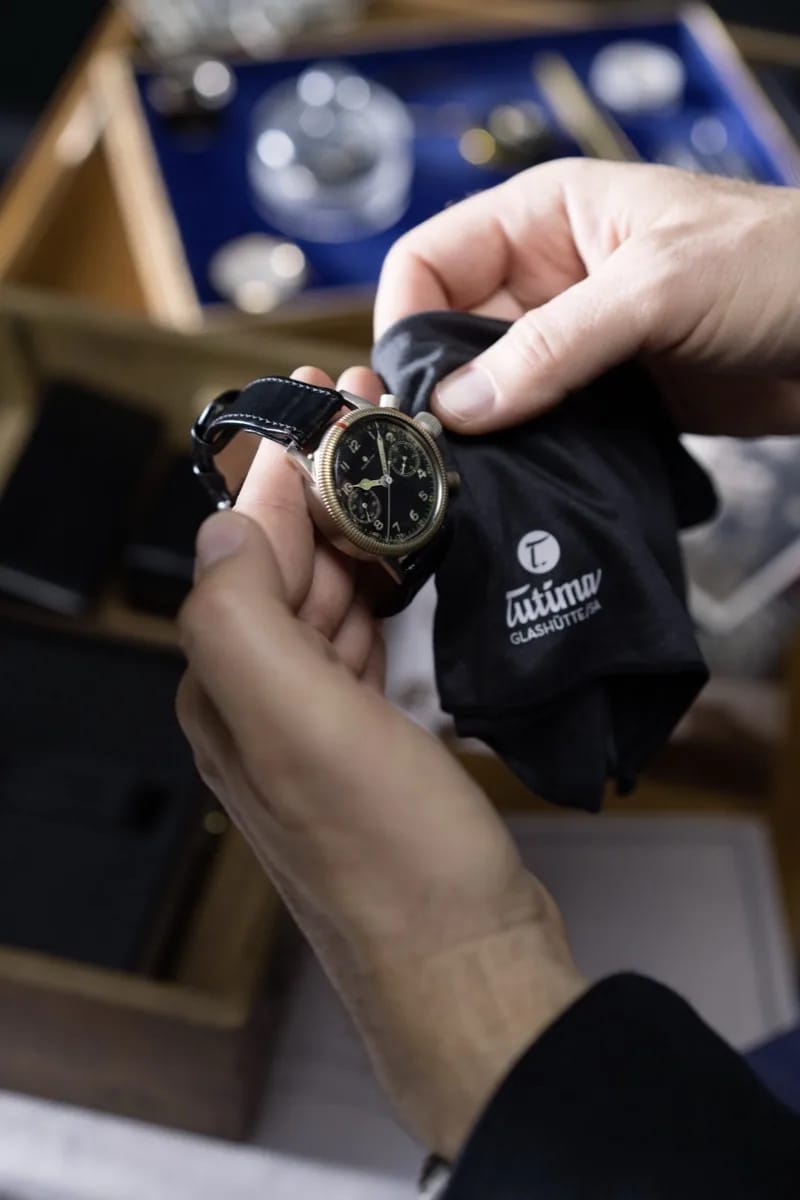
The Flieger watches that bear the name are not a marketing exercise borrowed from aviation history. They exist alongside an active training institution, living partnerships with competition pilots, and a sponsorship commitment to the German Aero Club that has run since 2004. The watch that sits on a pilot's wrist was shaped by the same relationships that built the Academy's curriculum.