Hommage: Three Years, One Sound
Three years of development. Sound geometry tuned with the TU Dresden Institute for Musical Instrument Construction. Hours at concert pitch A (440 Hz). Minutes at high C. Tone springs mounted on the case, not the movement — a first in watchmaking.
On May 12, 2011, in the renovated Bahnmeisterei in Glashütte — the former railway track-master's office that became Tutima's home — Rolf Lang's team presented the Hommage Minute Repeater.
Strictly speaking, it was the first true Glashütte minute repeater. Previous repeaters built in the town, in the 18th and 19th centuries, always used purchased Swiss ébauches from the Vallée de Joux. The mechanism was designed elsewhere and finished locally. The Hommage was different. Caliber 800, over 550 components, was developed and manufactured entirely in Glashütte.
The sound was the point. Hours ring in a lower tone tuned to concert pitch A at 440 Hz. Minutes ring in a higher tone at high C, 264 Hz. Quarter hours ring in a double stroke — low, then high. You count the strikes to know the time. This is the original purpose of the repeater, dating to the 17th century, when watches had no luminous dials and no one could read the time in the dark.
Tutima's team worked with the TU Dresden Institute for Musical Instrument Construction to optimize the sound geometry. The critical difference: tone springs attached to the case rather than to the movement. In conventional repeaters, the gongs are mounted on the movement plate. The sound must travel through the movement, through the case, and out. Each transition absorbs energy and dampens the tone. By mounting the springs directly on the case, the resonance body becomes the case itself. The sound projects outward without passing through intermediate layers. Fuller. Richer. Louder.
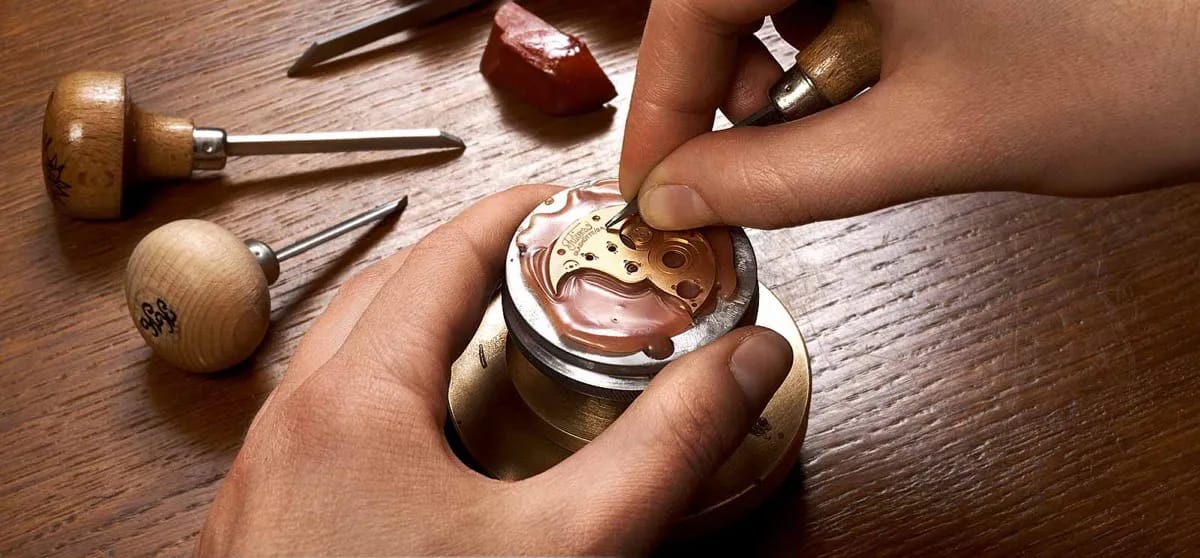
Ernst Kurtz, Tutima's founder, was a convinced anthroposophist who only accepted apprentices if they also played a musical instrument — or were at least willing to lea one. The hand-engraved balance cock on the Hommage carries a musical note symbol. A coincidence of metallurgy and music that Kurtz would have appreciated.
The movement measures 32 millimeters in diameter and 7.2 millimeters in height. Three-quarter plate construction in the Glashütte tradition. 42 jewels, four in gold chatons. Hand-engraved balance cock. Breguet overcoil balance spring. 65-hour power reserve. 21,600 semi-oscillations per hour — a conservative 3 Hz frequency that matches the pace of historical Glashütte watchmaking rather than chasing mode high-beat rates.
The case was offered in 43-millimeter rose gold or platinum. Fifteen rose gold units with closed dial. Five with an open dial revealing the repeater mechanism. Five platinum units with open dial only. The platinum version was priced at €179,000 — not because of the metal, but because of the three years that went into the sound.
The Hommage was dedicated to Dr. Ernst Kurtz, who died in 1996 at age ninety-seven in Ganderkesee. He never saw the retu to Glashütte. He never heard the minute repeater that bears his tribute. But the team he started built it — in the town where he began, using the approach he insisted on: everything made in-house, everything ea ed.