PVD: Harder Than Sapphire
Steel hardened to 1,200 Vickers, then PVD-coated to 2,000. Without the hardened base, the coating cracks like an eggshell on soft bread.
Sapphire crystal measures approximately 1,800 on the Vickers hardness scale. It is the second-hardest transparent material after diamond. Every serious watchmaker uses it. Most believe nothing on a wristwatch can be harder.
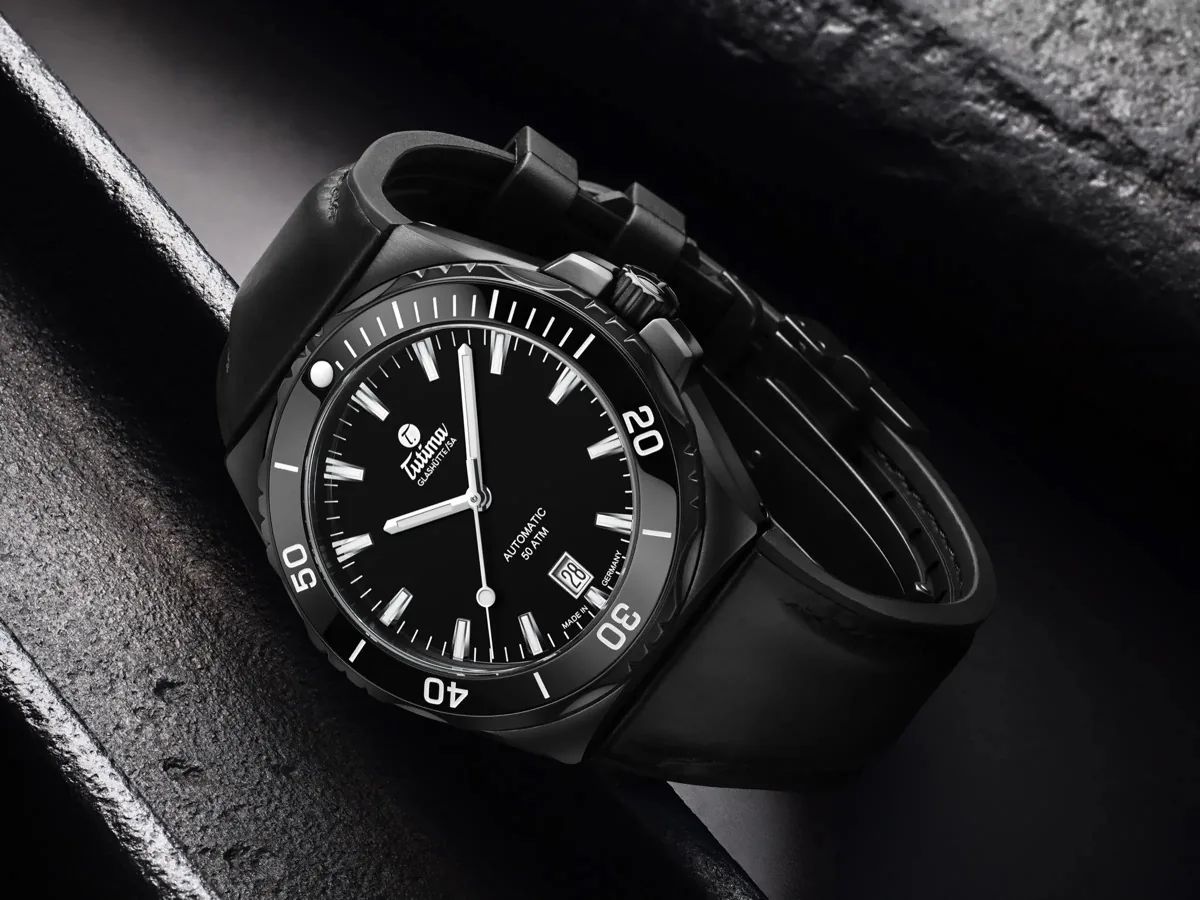
In 2023, Tutima released the M2 Seven Seas S Black Limited Edition (Ref. 6156-13) with a case that exceeds sapphire hardness. The process: stainless steel hardened first to 1,200 Vickers, then coated with black PVD (Physical Vapor Deposition) to reach 2,000 Vickers. 250 pieces.
The sequence matters. PVD coating alone — applied to standard, unhardened steel — creates a brittle shell over a soft substrate. Press hard enough and it dents, the coating cracking like an eggshell on soft bread. The outer layer is hard but has nothing to push back against.
Tutima's approach hardens the steel first. The case goes through a proprietary hardening process to 1,200 Vickers — already several times harder than standard 316L stainless steel at roughly 200 Vickers. Only then does the PVD layer go on. The result is a coating that sits on a foundation nearly as hard as itself. No eggshell problem.
The Seven Seas S Black carries this hardened case at 40 millimeters with a ceramic bezel and zero marker. Inside, the self-winding Tutima Calibre 330 with Tutima gold seal drives a date display at 6 o'clock. Super-LumiNova hands and indices. Pressure-tested to 50 atmospheres — 500 meters. The bicomponent strap pairs impregnated water-resistant leather on the outside with a rubber interior.
The numbers: 200 Vickers for standard watch steel. 1,200 after hardening. 2,000 after PVD. 1,800 for sapphire. The case is harder than the crystal that protects the dial. That is not a marketing claim. It is a measurement.